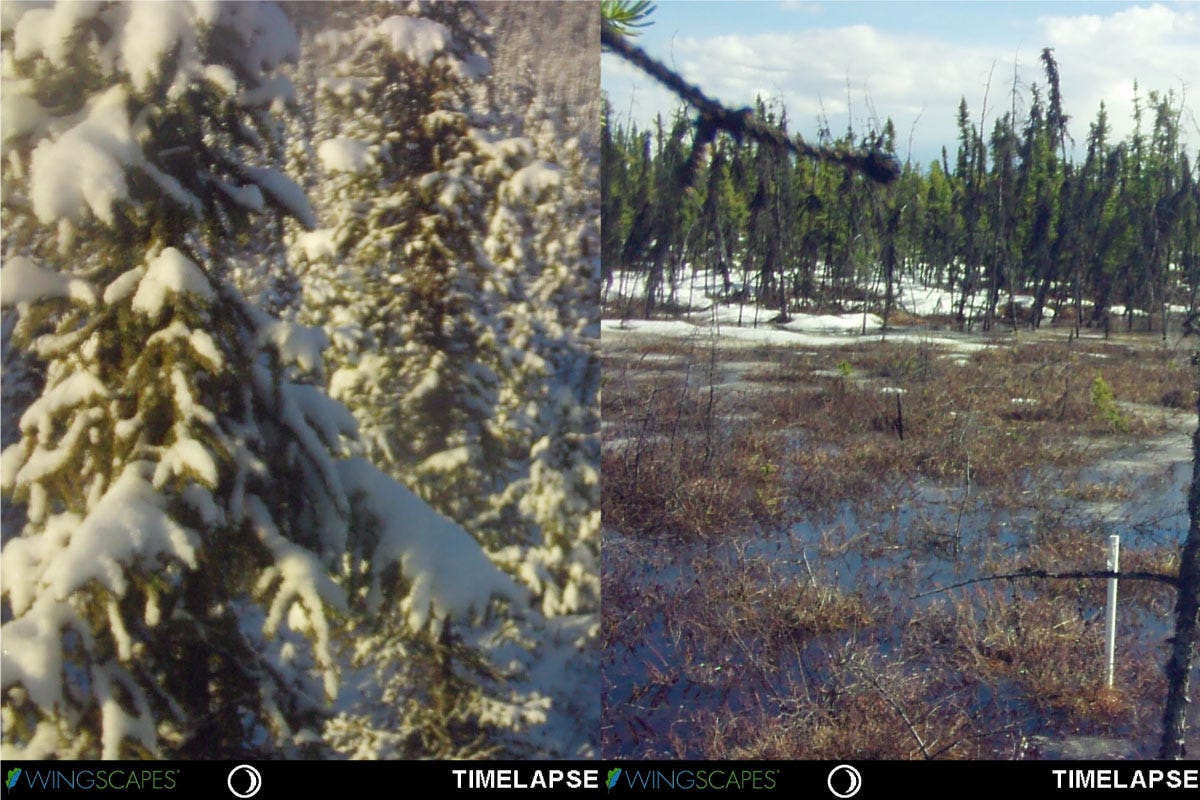
The weight of snow can be deceptive. Light and fluffy as it appears, it’s actually quite heavy when it begins to pile up. Depending on how much water content any particular accumulation of snow contains, between three to ten inches of it may be equivalent in weight to one inch of liquid water.
That may not seem like much at first glance. After all, a heavy day of rain might see an inch of it fall over twenty-four hours. However whereas rain falls just a little at a time and runs off, snow falls and stays where it first fell, putting quite a lot of weight on wherever it collects.
Just take a look at this Wingscapes time lapse video of a brief snowfall that janmikky recorded in the UK. It doesn’t take long at all for the bushes to be compressed to less than half their height by the weight of the accumulating snow.
For more wonderful time lapse videos, please visit the Wingscapes YouTube and Facebook pages.
Despite their name, Fishers do not catch fish. Much larger than their cousins the weasels, Fishers are actually very effective hunters, relying mostly on small to medium sized rodents for their primary prey (however they will hunt other animals as large as porcupines).
Like many other mammalian carnivores, Fishers are primarily active at night; which is why few people ever get the chance to see one. Fortunately, Heather had her Wingscapes BirdCam 2.0 positioned in just the right location one recent snow-covered January night in Norton, Massachusetts to record this beautiful BirdCam Life List photo of one.
Brilliant work indeed, Heather, and many thanks!

For more photos and videos of mammals, please visit the Wingscapes' Youtube channel and Facebook page.
While we’ve seen a wide variety of things recorded with our Wingscapes TimelapseCam 8.0 - from plants growing to wedding receptions to home remodling projects, we have to stop and doff our caps in profound respect to the folks at the Oregon Department of Transportation who made the decision to record this time lapse video of a construction project of truly monumental proportions: the moving of an entire bridge.
Originally constructed in 1925 to span the Willamette River that cuts through the city of Portland, Oregon, the Sellwood Bridge simply could not handle the increasing weight or volume of traffic a Twenty-first century city requires. Thus as part of a reconstruction project begun in 2006, the movement of its entire 1,100 foot span was necessary. We’re not sure if it was one of our cameras that recorded it but we’re darned impressed regardless with such a massive object being moved so successfully and the forethought of the engineers to record it in time lapse video as documentation of it working so well.
For more amazing time lapse videos, please visit the Wingscapes YouTube and Facebook pages.
Like all bird watchers, we eagerly await the sighting of the first bird of the new year. We know that in reality it is just a matter of chance but - like millions of other bird watchers the world over - we can’t help but feel that it is somehow indicative of how the year will play out for bird sightings.
Unlike other bird watchers, however, our sightings at Wingscapes are counted a bit differently. We rely on contributors to our BirdCam Photo Gallery to provide us with our list of birds “seen” then add the first sighting of each to our BirdCam Life List.
Thus when Hob from Kawaii, Hawaii uploaded this absolutely spectacular Audubon BirdCam image of a Laysan Albatross as the first bird of 2013 in the BirdCam Photo Gallery we were overjoyed! With such a first bird of the year, our hopes are higher than they ever have been for what we will see uploaded during the rest of 2013.

For more exotic bird feeding photos and videos, please visit the Wingscapes Youtube channel, Facebook page and our BirdCam Photo Gallery.
When packing for a tropical cruise there are a a number of things you’ll want to remember to include. Sunscreen for sure. A good book or two to read by the pool. And of course a Wingscapes TimelapseCam 8.0.
Why a TimelapseCam? Well, just take a look at this time lapse video of the return of a cruise ship into Baltimore from the Bahamas that was recently added to TheWeavers101 channel on YouTube. Simply by positioning their Wingscapes cameras (they brought two - a PlantCam and a ProjectCam) and setting them to record the passing scenery they were able to produce this superb video of their ship returning to port.
TheWeavers101 channel has many other Wingscapes time lapse videos, one of which we featured in this very blog back in January 2012. We’re delighted to see that they’re still actively enjoying their Wingscapes time lapse cameras.
For more cool time lapse videos, please visit the Wingscapes YouTube and Facebook pages.
Here’s something you won’t see every day, or any “day” for that matter, because Ringtails such as this one are only active at night.
Small carnivorous mammals that look like a combination of a fox, a cat, and a raccoon, Ringtails sleep most of the day and venture out after dark in search of a wide range of prey from small birds and rodents to grasshoppers and crickets.
Matt of Johnson City, Texas recorded this one using a Wingscapes BirdCam 2.0 during the collection of data for his thesis on the effects of urbanization on mammalian carnivores. We certainly wish him well in his research and hope he lets us know when it’s complete; we’d love to read it.

For more photos and videos of rare animals, please visit the Wingscapes' Youtube channel and Facebook page.
As 2012 came to a close, you no doubt were presented with the opportunity to partake in a whole host of “year in review” compilations on your favorite television, radio, or social media channel. We certainly saw our share as well. However of all those we watched, one of our favorites is Wingscapes timelapse videographer SkewToob’s recording of the entire growing season of his garden compressed into three minutes and twenty-four seconds.
Particularly impressive is the last five seconds of the recording, during which the slow and graceful growth of the plants is brought to an astonishingly abrupt end by a… well, we don’t want to ruin it for everyone. You’ll just have to watch it to find out. We’re confident you’ll think it’s worth it.
For more cool time lapse videos, please visit the Wingscapes YouTube and Facebook pages.
If you’re a skier, you probably know Snowbird as one of North America’s great ski resorts. If you’re a fan of country-folk music, Snowbird is likely best know to you as one of Anne Murray’s most popular songs. But if you’re a bird watcher in the U.S. or Canada, the Dark-eyed Junco is your Snowbird.
These short-winged little grey sparrows - such as the one shown here recorded with an Audubon BirdCam while visiting a Wingscapes AutoFeeder on the Oregon property of The Well-read Naturalist - earned their name from their migration habits. All across North America, they begin to appear in the mid-latitudes just as the colder temperatures of late autumn begin and then head back north as spring blossoms.

For more Junco feeding photos and videos, please visit the Wingscapes Youtube channel and Facebook page.
If you’ve seen the blockbuster animated movie The Lion King - and if the box office, DVD sales, and other related figures are correct, you very likely have - you undoubtedly remember Zazu, the officious and somewhat pompous bird who served as majordomo to King Mufasa. But what you might not know is that Zazu was modeled (physically, at least) after a species of African bird: the Red-billed Hornbill.
However in real life, Red-billed Hornbills are nothing like the overly formal and fastidious Zazu. As this Wingscapes BirdCam video clip recorded by GlobalBirdTrekkers of Red-billed Hornbills feeding alongside a few Crested Francolin on the Hoedspruit Wildlife Estate, South Africa shows, they are perfectly sociable omnivorous birds not at all opposed to a “catch-as-catch-can” meal.
For more exotic bird feeding photos and videos, please visit the Wingscapes Youtube channel and Facebook page.
For those living in North America, do not adjust the color settings of your computer monitor - for while these two birds may look like the chickadees and goldfinches that commonly visit your own feeders, they are in fact the European cousins of those familiar birds.
Very familiar to all those who feed birds in England and continental Europe, Great Tits and Goldfinches (sometimes also called Eurasian Goldfinches) share many of the same habits and behaviors of their North American cousins.
These two particular birds were recorded by Colin in Welwyn Garden City in England using his BirdCam 2.0. Colin has been uploading quite a few photos to the BirdCam Photo Gallery recently of the birds that visit his UK garden feeders. We highly recommend having a look through his gallery.

For more Great Tits and Goldfinches feeding photos and videos, please visit the Wingscapes Youtube channel and Facebook page.